Model-View-Controller (MVC) Software Architecture Pattern
(Redirected from Model-View-Controller Pattern)
A Model-View-Controller (MVC) Software Architecture Pattern is a software architecture pattern that separates information representation from user interaction.
- Context:
- It can be followed by an MVC Platform.
- …
- Counter-Example(s):
- See: MVVM Pattern, Web Application Framework, Scala Play Platform.
References
2013
- http://en.wikipedia.org/wiki/Model%E2%80%93view%E2%80%93controller
- Model–view–controller (MVC) is a software architecture pattern which separates the representation of information from the user's interaction with it.[1][2] The model consists of application data, business rules, logic, and functions. A view can be any output representation of data, such as a chart or a diagram. Multiple views of the same data are possible, such as a bar chart for management and a tabular view for accountants. The controller mediates input, converting it to commands for the model or view.[3]
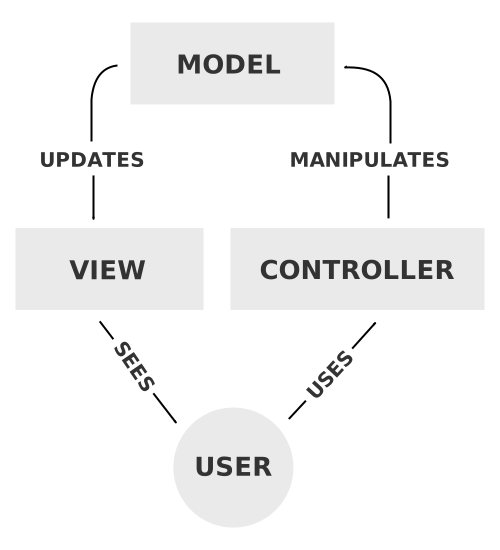
- ↑ "More deeply, the framework exists to separate the representation of information from user interaction." The DCI Architecture: A New Vision of Object-Oriented Programming - Trygve Reenskaug and James Coplien - March 20, 2009.
- ↑ "... the user input, the modeling of the external world, and the visual feedback to the user are explicitly separated and handled by three types of object." Applications Programming in Smalltalk-80(TM):How to use Model-View-Controller (MVC).
- ↑ Simple Example of MVC (Model View Controller) Design Pattern for Abstraction
2021
- https://www.freecodecamp.org/news/the-model-view-controller-pattern-mvc-architecture-and-frameworks-explained/
- QUOTE: MVC stands for model-view-controller. Here's what each of those components mean:
- Model: The backend that contains all the data logic
- View: The frontend or graphical user interface (GUI)
- Controller: The brains of the application that controls how data is displayed
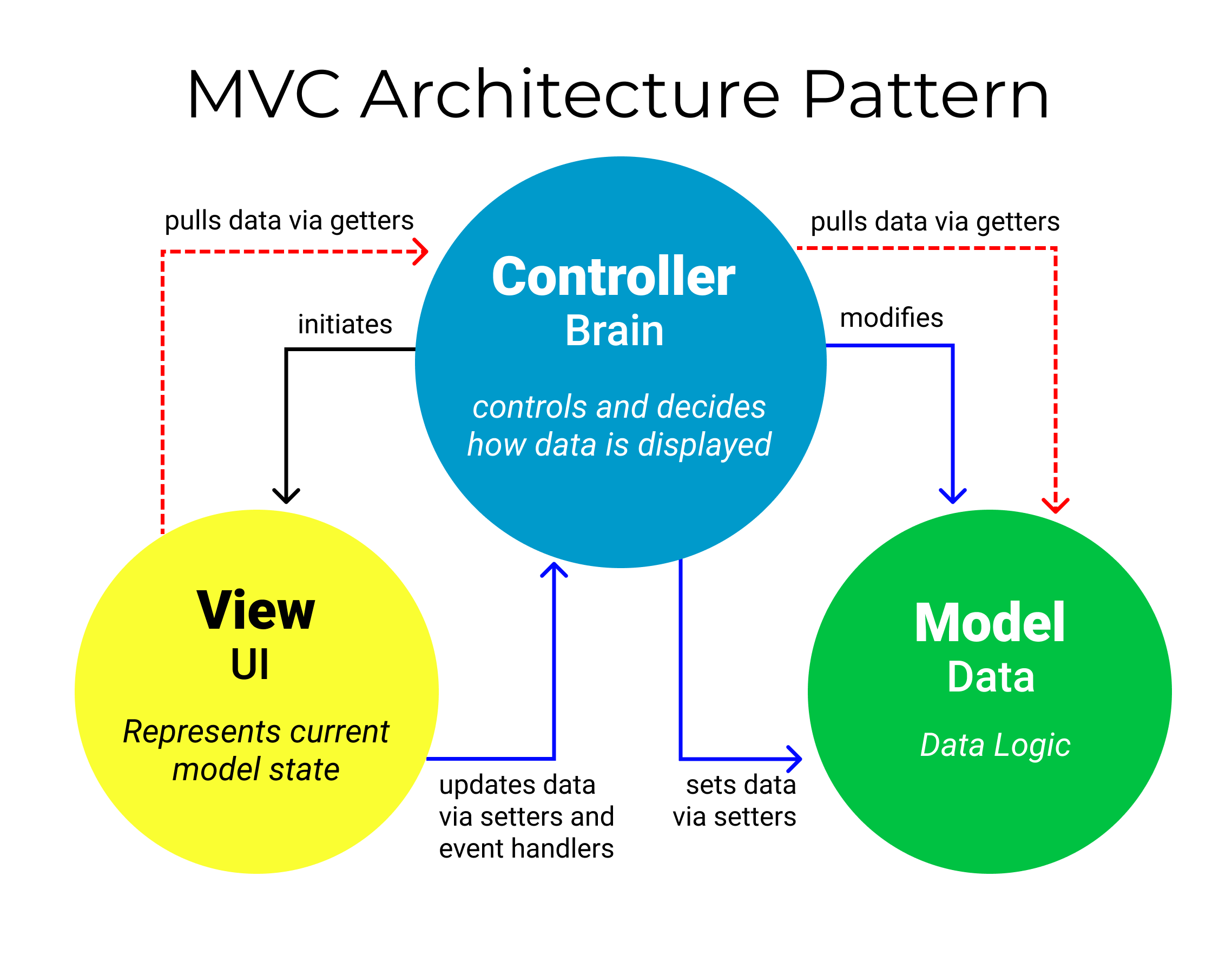
- QUOTE: MVC stands for model-view-controller. Here's what each of those components mean: